Introduction
Writing a book is an exciting achievement, but finishing your manuscript is only the beginning. The next step publishing your book can feel overwhelming, especially if it’s your first time. With so many publishing options, editing services, printing methods, and marketing strategies available today, it’s easy to feel unsure about where to start.
The good news is that publishing a book has never been more accessible. Digital technology, online bookstores, and print-on-demand services have opened the doors for authors around the world. Whether you’re writing fiction, nonfiction, children’s books, memoirs, or business guides, you now have more opportunities than ever to reach readers.
However, many new authors believe that publishing is as simple as uploading a manuscript online. In reality, successful publishing involves much more. It requires planning, professional editing, eye-catching design, effective distribution, and ongoing marketing.
Understanding the complete publishing journey before investing your time and money can help you avoid expensive mistakes. It also helps you choose the right publishing path based on your goals, budget, and audience.
In this guide, we’ll walk through every major step of the publishing process. You’ll learn how to prepare your manuscript, understand different publishing models, choose a reliable publishing partner, and create a long-term strategy for success.
One of the most important decisions you’ll make is choosing the right publishing company. A professional partner can make the process smoother while helping you produce a book that readers will enjoy. If you’d like to learn more, you can also explore Who Is Global Publication House? and How Global Publication House Helps Authors Publish Smarter later in this guide.
What Does Publishing a Book Really Mean?
Many people think writing and publishing are the same thing. They’re not.
Writing is the creative process of turning your ideas into a finished manuscript. Publishing is the business process of preparing that manuscript for readers and making it available through bookstores, online retailers, libraries, and digital platforms.
Another common misunderstanding is confusing publishing with printing.
Printing simply creates physical copies of your book. Publishing includes editing, formatting, cover design, ISBN registration, distribution, marketing, and sales. Printing is only one step in a much larger journey.
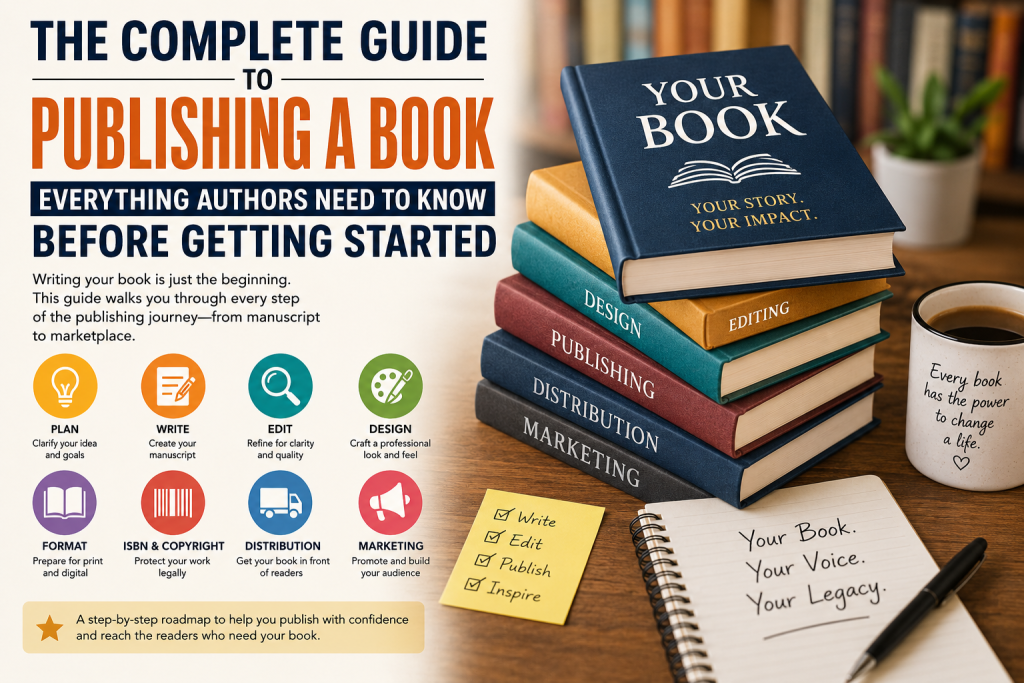
Once your manuscript is complete, several important tasks still remain:
- Professional editing
- Interior formatting
- Cover design
- ISBN assignment
- Copyright protection
- Printing or digital conversion
- Distribution
- Marketing
Think of publishing as launching a new product. Your book deserves the same planning and preparation as any successful business.
Why Proper Planning Before Publishing Matters
Planning early can save both time and money.
Many first-time authors rush to publish immediately after finishing their manuscript. Unfortunately, this often leads to disappointing sales, poor reviews, or unnecessary expenses.
Instead, ask yourself a few simple questions:
- Who is my ideal reader?
- What problem does my book solve?
- Where will readers discover my book?
- What are my long-term publishing goals?
Having clear answers helps you make smarter decisions throughout the process.
Planning also allows you to build your author brand before your book launches. Readers don’t just buy books—they connect with authors they trust. Creating a professional website, growing an email list, and building a social media presence can make a significant difference over time.
Setting realistic expectations is equally important. Very few books become overnight bestsellers. Success usually comes from consistent marketing, reader engagement, and publishing quality content over time.
Step 1 – Finish and Refine Your Manuscript
Complete Your Draft
Your first goal is simple: finish writing your manuscript.
Don’t worry about making every chapter perfect during the first draft. Focus on getting your ideas onto the page. You can improve them later.
Many successful authors say the first draft is simply the beginning of the editing process.
Self-Editing
Before hiring an editor, spend time reviewing your own work.
Look for:
- Grammar mistakes
- Repeated words
- Weak sentences
- Plot inconsistencies
- Missing information
- Awkward dialogue
Reading your manuscript aloud often helps you spot problems that are easy to miss on screen.
Beta Readers
Beta readers provide valuable feedback before professional editing begins.
Choose readers who represent your target audience. Ask them honest questions:
- Was the book engaging?
- Were any chapters confusing?
- Which parts felt slow?
- Would they recommend it?
Constructive feedback helps strengthen your manuscript before publication.
Professional Editing
Professional editing remains one of the best investments an author can make.
Different editing services focus on different areas:
Developmental Editing
Improves structure, pacing, organization, and overall storytelling.
Line Editing
Enhances sentence flow, clarity, tone, and readability.
Copy Editing
Corrects grammar, spelling, punctuation, and consistency.
Proofreading
The final review before publication, catching small errors that remain after editing.
Skipping professional editing often results in negative reviews and lower reader satisfaction.
Step 2 – Understand Your Publishing Options
Every author has different goals. That’s why choosing the right publishing model matters.
Traditional Publishing
Traditional publishers usually handle editing, design, printing, and distribution after accepting your manuscript.
Advantages
- Professional publishing support
- Industry credibility
- Wider bookstore access
- No upfront publishing costs in most cases
Disadvantages
- Highly competitive
- Long approval process
- Lower royalty percentages
- Less creative control
Self-Publishing
Working with a Self Publishing Company gives authors more control over the publishing process.
Benefits
- Faster publication
- Higher royalty potential
- Full creative control
- Ownership of publishing decisions
Challenges
- Upfront investment
- Greater responsibility
- Marketing becomes the author’s responsibility
- Choosing reliable service providers requires research
Many authors compare Global Publication House reviews before selecting a publishing partner because customer experiences often reveal how transparent, supportive, and professional a company is throughout the publishing journey.
Hybrid Publishing
Hybrid publishing combines elements of traditional and self-publishing.
Authors typically invest in publishing services while receiving professional assistance with editing, design, production, and distribution.
This model works well for writers who want expert guidance without giving up ownership of their work.
Publishing Model Comparison
| Feature | Traditional | Self-Publishing | Hybrid |
| Creative Control | Low | High | High |
| Upfront Cost | Usually None | Yes | Yes |
| Royalties | Lower | Higher | Moderate to High |
| Publishing Speed | Slow | Fast | Moderate |
| Marketing Support | Limited | Mostly Self | Often Included |
| Rights Ownership | Sometimes Shared | Usually Author | Usually Author |
Step 3 – Choose the Right Publishing Partner
Not every publishing company offers the same level of service. Taking time to evaluate your options can save you from frustration later.
Look for a publishing partner that offers:
- Professional editing
- Experienced designers
- Transparent pricing
- Responsive communication
- Distribution support
- Marketing guidance
- Clear ownership agreements
- Positive customer feedback
Many authors researching Global Publication House begin by reading independent Global Publication House reviews to better understand the experiences of previous clients before making a decision.
Step 4 – The Complete Publishing Process Explained
Publishing a book is a step-by-step journey. Each stage builds on the one before it.
Workflow
Idea
↓
Writing
↓
Editing
↓
Formatting
↓
Cover Design
↓
ISBN
↓
Copyright
↓
Printing
↓
Distribution
↓
Marketing
↓
Book Sales
Every step matters. Skipping one can affect your book’s quality, visibility, or sales potential.
Step 5 – Preparing Your Book for Publication
Before your book reaches readers, make sure every detail is polished.
Professional Editing
Even the best writers benefit from a professional editor. Fresh eyes can spot mistakes, improve clarity, and strengthen your manuscript.
Interior Formatting
A well-formatted book is easier to read. Proper spacing, fonts, margins, and chapter layouts create a professional reading experience across print and digital formats.
Book Cover Design
Readers often judge a book by its cover. An attractive, genre-appropriate cover can increase clicks and encourage more purchases.
Metadata Optimization
Metadata includes your title, subtitle, keywords, categories, and book description. Optimizing these details improves discoverability on online bookstores and search engines.
Many authors looking for Affordable Book Publishing Services choose providers that include editing, formatting, cover design, and metadata optimization in one package.
Step 6 – ISBNs, Copyright, and Publishing Essentials
Several publishing elements help protect your work and make it easier for readers to find.
- ISBN: A unique number used to identify your book.
- Barcode: Required for most printed books sold through retailers.
- Copyright Registration: Helps protect your intellectual property.
- Library Registration: Makes your book more accessible to libraries.
- Author Profiles: Build credibility on platforms like Amazon Author Central.
- Metadata: Helps search engines and bookstores categorize your book correctly.
Step 7 – Choosing the Right Book Format
Today’s readers enjoy books in different formats. Offering more than one version can expand your audience.
| Format | Best For | Benefits |
| Paperback | Everyday readers | Affordable and portable |
| Hardcover | Collectors and gifts | Premium appearance |
| eBook | Digital readers | Instant worldwide delivery |
| Audiobook | Busy listeners | Growing market and convenience |
| Large Print | Accessibility | Easier reading for many audiences |
Choose formats that match your readers’ preferences and your publishing goals.
Step 8 – Printing Options Explained
There are two primary ways to print books.
Print-on-Demand (POD)
Books are printed only when customers place an order.
Advantages
- Low upfront investment
- No inventory storage
- Reduced financial risk
Disadvantages
- Higher cost per copy
- Fewer customization options
Offset Printing
Large quantities of books are printed at one time.
Advantages
- Lower cost per book
- Excellent print quality
- Ideal for bulk orders
Disadvantages
- Higher initial investment
- Requires storage space
If you’re publishing your first book, Print-on-Demand is often the safest choice.
Step 9 – Book Distribution: How Your Book Reaches Readers
Publishing your book is only the beginning. Distribution ensures readers can actually buy it.
Your book can be sold through:
- Online retailers
- Independent bookstores
- Major bookstore chains
- Libraries
- International distributors
- Wholesale networks
- Digital bookstores
Common distribution platforms include Amazon KDP, IngramSpark, Apple Books, Kobo, Google Play Books, and Barnes & Noble Press.
Learning how these platforms work is an important part of any Global Book Distribution Guide because each offers different benefits depending on your publishing goals.
Step 10 – How Much Does It Cost to Publish a Book?
Publishing costs vary based on the services you need.
| Service | Estimated Cost |
| Editing | $500–$3,000+ |
| Cover Design | $200–$800 |
| Formatting | $100–$500 |
| ISBN | Varies by country |
| Copyright Registration | Varies |
| Printing | Based on quantity |
| Marketing | $200–$5,000+ |
Some companies bundle these services into Affordable Book Publishing Services, helping authors simplify the publishing process while managing costs.
Step 11 – Building Your Author Platform
Successful authors market themselves—not just their books.
Focus on building:
- A professional author website
- Social media profiles
- An email newsletter
- A consistent author brand
- An Amazon Author Page
- A helpful blog
The stronger your online presence, the easier it becomes to connect with readers and grow your audience.
Step 12 – Book Marketing Before and After Launch
Marketing should begin long before publication day.
Before Launch
- Recruit ARC readers
- Build an email list
- Create a landing page
- Offer pre-orders
Launch Week
- Publish press releases
- Share on social media
- Appear on podcasts
- Schedule interviews
- Run paid advertising
After Launch
- Collect reader reviews
- Publish SEO-friendly blog articles
- Continue content marketing
- Accept speaking opportunities
- Engage with your audience regularly
Marketing is an ongoing process, not a one-time event.
How Smart Publishing Strategies Help Authors Succeed
Successful publishing is about much more than releasing a finished manuscript.
Professional authors focus on:
- Quality editing
- Strategic distribution
- Metadata optimization
- Long-term marketing
- Reader engagement
- Personal branding
Readers interested in learning more about this approach can also explore How Global Publication House Helps Authors Publish Smarter as a complementary resource.
Whether you work independently or with a Self Publishing Company, having a clear publishing strategy will improve your chances of long-term success.
Common Publishing Mistakes First-Time Authors Make
Avoid these common mistakes:
- Publishing before the manuscript is ready
- Skipping professional editing
- Using a weak cover design
- Ignoring formatting
- Overlooking SEO
- Having no marketing plan
- Expecting instant bestseller results
- Choosing the wrong publishing company
- Signing contracts without understanding the terms
Taking your time now can save frustration later.
Questions Every Author Should Ask Before Hiring a Publishing Company
Before signing any agreement, ask these questions:
- What services are included?
- Who owns the ISBN?
- Who owns the publishing files?
- Which distribution channels are available?
- What marketing support is included?
- How are royalties paid?
- Will I retain full rights to my book?
- What happens after publication?
Clear answers help you make confident decisions.
Publishing Timeline: What to Expect
A typical publishing timeline looks like this:
Writing
↓
Editing
↓
Design
↓
Formatting
↓
Proof Approval
↓
Publishing
↓
Distribution
↓
Marketing
Depending on your project, the complete process may take anywhere from a few months to a year.
Frequently Asked Questions
1. How long does it take to publish a book?
Most books take between three and twelve months, depending on editing, design, and production.
2. How much does publishing cost?
Costs vary based on the services and publishing model you choose.
3. Can I publish without a publisher?
Yes. Many authors successfully self-publish.
4. Should I copyright my book?
Yes. Copyright helps protect your original work.
5. Do I need an ISBN?
Yes, especially if you plan to sell printed books through retailers.
6. Can I publish internationally?
Absolutely. Many distribution platforms offer global reach.
7. What is Print-on-Demand?
It prints books only after a customer places an order.
8. How do royalties work?
Royalties are the percentage of each sale paid to the author.
9. Which publishing option is best for first-time authors?
It depends on your goals, budget, and desired level of support.
10. How can I market my book successfully?
Build your audience early, collect reviews, create valuable content, and stay active online.
11. Can I publish an eBook and paperback together?
Yes. Many authors launch multiple formats at the same time.
12. Why is distribution important?
Without effective distribution, readers may never discover your book.
Conclusion
Publishing a book is much more than uploading a manuscript or printing copies. It’s a complete process that includes careful planning, professional editing, thoughtful design, smart distribution, and consistent marketing.
By understanding every stage of the journey, you’ll make better decisions, avoid common mistakes, and give your book the strongest possible chance of success. Whether you’re publishing your first novel or your fifth business book, investing in quality and planning for the long term will always pay off.
If you’re researching publishing companies, you can also read Who Is Global Publication House? to learn how a modern publishing partner supports authors from manuscript preparation to global distribution.These complementary resources can provide additional insight into how a professional publishing partner can support authors from manuscript to marketplace.
Remember, great books deserve more than publication they deserve a strategy that helps them reach the readers they’re written for.